New research questions if Hal Finney was really Bitcoin’s second user
New forensic research published yesterday suggests that Hal Finney might not have been the second person to run a BTC node. For 17 years, the man who tweeted “Running bitcoin” earned an unofficial title. In the eyes of m...
Archive context
Older archive item. Useful for background and entity history, but not a fresh market-moving signal.

New forensic research published yesterday suggests that Hal Finney might not have been the second person to run a BTC node.
For 17 years, the man who tweeted “Running bitcoin” earned an unofficial title. In the eyes of many Bitcoin historians, Finney was the second person after creator Satoshi Nakamo to run a Bitcoin node.
Indeed, thousands of articles credit Finney as Bitcoin’s second participant.
However, it turns out that he might actually have been the third.
Although it is an indisputable, on-chain fact that Finney earned the first coinbase reward after Nakamoto for mining a block, forensic researcher Alex Waltz argues that another man was running a mining-capable node before Finney.
According to Waltz’s timestamps, although Dustin Trammell was running a node before Finney, an idiosyncratic network connectivity issue in Bitcoin software prior to version 0.1.3 prevented Trammell from connecting to Nakamoto’s nodes fast enough to outpace Finney.
What everyone knows about Bitcoin's Launch is wrong.
(full research 1st comment) pic.twitter.com/44OTcmakQ4
Waltz reconstructed a precise timeline of events during Bitcoin’s opening days.
Based on his analysis, and despite Trammell openly admitting that Finney mined a block before him, he believes that Trammell was running BTC mining software first.
Unfortunately, Trammell hadn’t remembered to flip on the software switch to actually mine. Still, according to Waltz, he was probably technically running the node software before Finney.
It’s important to remember that in January 2009, a Bitcoin wallet holder, Bitcoin node operator, and a BTC miner were often the same thing.
The early Bitcoin software client bundled wallet, node, and CPU mining software into one program. The node turned on immediately by default, the wallet was built-in, and mining began using that same software after a simple flip of a software switch.
Critically, running a passive, non-mining node wasn’t a common practice in 2009, despite its widespread popularity today.
Indeed, there’s at least an order of magnitude more non-mining Bitcoin node operators today than BTC miners. Not so in 2009.
Anyway, given this context, Waltz’s analysis leans on an email that Nakamoto sent to Trammell to place Trammell’s node ahead of Finney’s node in the revised Bitcoin timeline.
‘You couldn’t broadcast it to the network, so it didn’t get into the chain’Here’s what happened.
Late in the day on January 12, 2009, Trammell emailed Nakamoto that he’d still been running Bitcoin software version 0.1.1 for a while, which earned an email response from Nakamoto urging Trammell to update to v0.1.3.
Importantly, that email response from Nakamoto on January 13, 2009 confirms that Trammell would have been experiencing a silent network communication outage with his out-of-date, v0.1.1 software.
“It’s the bug that was fixed in 0.1.3,” Nakamoto said.
“The communications thread would get blocked, so you would make connections, but they would go silent after a while.”
Nakamoto continued, “When you found a block, you couldn’t broadcast it to the network, so it didn’t get into the chain.”
As the creator of the software, Nakamoto apologized for the bug that misled Trammell on-screen about his node’s uptime status when in fact his node was disconnected.
“You weren’t receiving anything either to know that the network had gone on without you… This is all fixed in 0.1.3,” he wrote.
Satoshi ended his email to Trammell with a generous offer as a sort of apology for the bug: “If you give me your IP, I’ll send you some coins.”
That is a true moment of Bitcoin history.
With that, Waltz ends his argument for Trammell being the second operator of mining node software on the Bitcoin network.
Waltz then moves along to other curiosities about Bitcoin’s early weeks of operation.
Are we done Finding Satoshi?Read more: This wild Satoshi theory links Paul LeRoux and Craig Wright
Who is Bitcoin’s second user: Hal Finney or Dustin Trammell?Although the above argument isn’t irrefutably conclusive, it is somewhat compelling.
Not only does Trammell have evidence of unbroadcasted blocks from the earliest days of Bitcoin, which support Trammell’s claim about unreliable connectivity, he also has correspondence from Nakamoto acknowledging Trammell’s reason for not being able to broadcast blocks over the internet.
Plus, Nakamoto offers to compensate Trammell for his foregone coinbase reward.
It’s a true story that few people in the Bitcoin community have heard.
Now, of course, Trammell does not appear to have actually mined a block prior to Finney earning Bitcoin’s coinbase reward for Finney’s on-chain block 78 on January 10, 2009.
Still, Trammell might have been running a mining-capable node prior to block 78.
Obviously, whether running mining software while not mining constitutes being a “miner” will probably remain a matter of public debate.
Unseating Finney as Bitcoin’s second network participant will take even more heavy lifting by cryptographers and forensic investigators, yet Waltz has provided novel questions about the preeminence of Finney over less famous participants in the early Bitcoin community.
Rest in peace, Hal FinneyAll of these questions would be easy to resolve if we could simply ask Finney himself. Sadly, Finney isn’t around anymore.
After a long battle with Lou Gehrig’s disease, he passed away in 2014.
There is, however, one last piece of surprising evidence.
Trammell Venture Partners, which in 2022 launched a Bitcoin venture capital fund series, describes Dustin Trammell as “the second node on the Bitcoin network” on its own website.
Because miner and node operator were essentially the same thing at that time, Trammell has therefore quietly claimed the second-to-Nakamoto title that Finney long received as a community-ascribed belief.
After Waltz published his analysis, Trammell admitted that he hadn’t switched on the mining function to outpace Finney in actually mining a block before block 78, yet per his own website, Trammell otherwise maintains that he was running a node before Finney.
Got a tip? Send us an email securely via Protos Leaks. For more informed news and investigations, follow us on X, Bluesky, and Google News, or subscribe to our YouTube channel.
The post New research questions if Hal Finney was really Bitcoin’s second user appeared first on Protos.
Why this matters
Bitcoin is showing up inside the Mining theme, so this story is worth tracking for follow-through rather than treating it as a one-off headline.
Original source
Read on ProtosRelated market context
Chinese Communist Party Calls for a National Blockchain Network
The Central Committee of the Chinese Communist Party (CCP) has called for the creation of a national blockchain network to foster...

China calls for national blockchain network in new technology push
China's blockchain initiative could redefine global data markets, emphasizing state control and potentially influencing internatio...
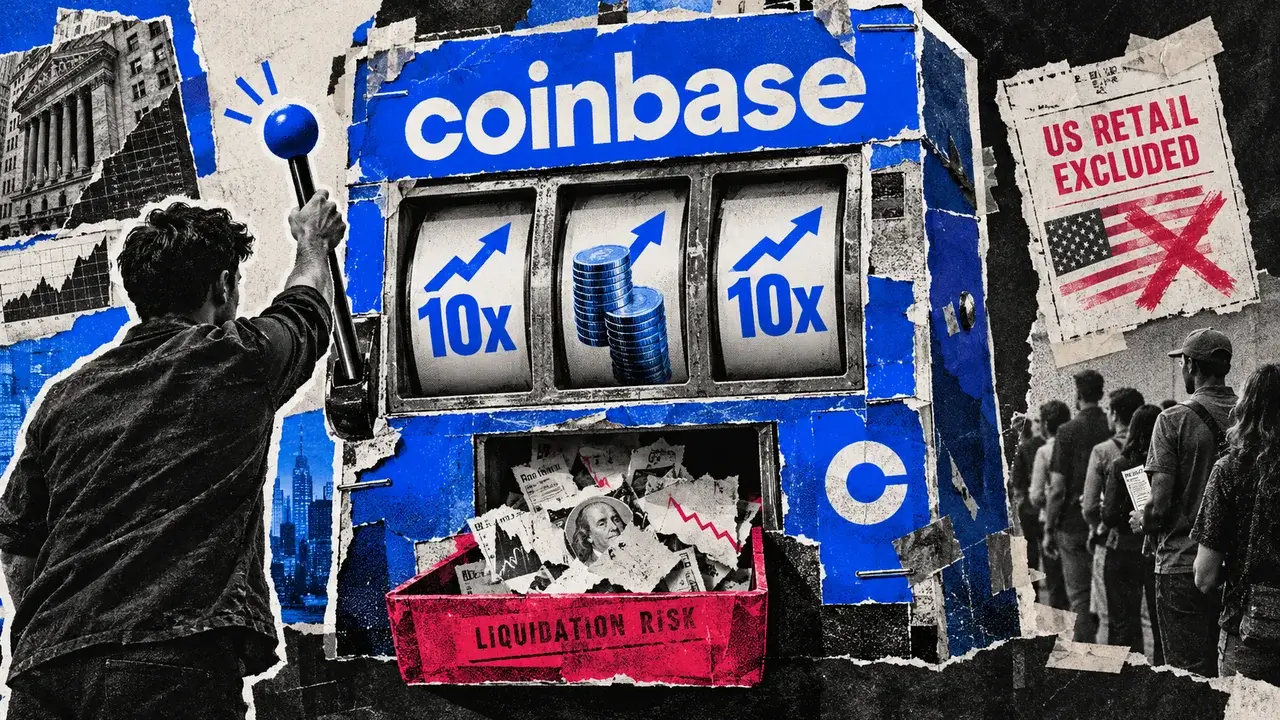
Coinbase rolls out 10x spot leverage, but blocks US retail from it
Coinbase plans to introduce spot borrowing with up to 10x leverage, letting eligible traders borrow against collateral to buy cryp...
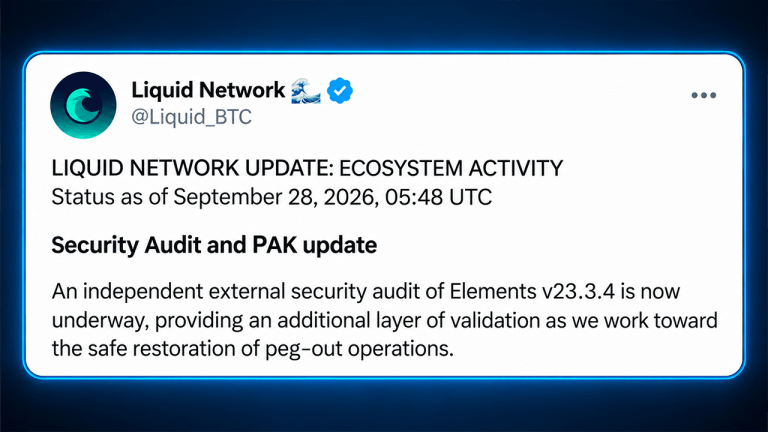
Liquid Network at 86% Backing as Bitcoin Redemption Freeze Drags On
It has been 35 days since an attacker exploited a vulnerability in the Liquid Network’s Elements software, draining nearly 4,000 B...

Samsung Wallet Brings USDC to 82M Galaxy Devices With Coinbase, Solana and Sui Support
Key Takeaways: Samsung Wallet will support 82 million U.S. Galaxy to add transfers on USDC. Coinbase will keep USDC in their Coinb...

Ripple Custody Adds Canton Network Support, Bringing CC and CIP-56 Into One Vault
Key Takeaways: Ripple Custody 1.43 adds support for Canton Network, CC and CIP-56 tokens. Institutions can be given the same custo...