DeFi Education Fund Urges Senate to Tread Carefully on DeFi Regulation in Joint Letter
The DeFi Education Fund (DEF), a policy advocacy group backed by an early Uniswap grant, has called on the US Senate Banking Committee to take a more measured approach to DeFi regulation. Key Takeaways: DEF urges the Sen...
Archive context
Older archive item. Useful for background and entity history, but not a fresh market-moving signal.
The DeFi Education Fund (DEF), a policy advocacy group backed by an early Uniswap grant, has called on the US Senate Banking Committee to take a more measured approach to DeFi regulation.
Key Takeaways:
- DEF urges the Senate to distinguish DeFi developers from intermediaries in regulation.
- The group warns that current rules risk criminalizing non-custodial software.
- DEF calls for federal preemption to prevent state-level attacks on DeFi innovation.
In a formal response to the draft Responsible Financial Innovation Act of 2025 (RFIA), DEF and a coalition of top crypto firms outlined a framework they believe can safeguard innovation without undermining national security or consumer protections.
The response was co-signed by a16z Crypto, Jito Labs, Jump Crypto, Paradigm, Multicoin Capital, Solana Policy Institute, Uniswap Foundation, Uniswap Labs, and Variant Fund.
DEF Calls for Clear DeFi Rules, Developer Protections in Senate ResponseThe DEF’s response pushes for four key pillars, including distinguishing between DeFi developers and intermediaries, defining which entities are required to register with federal authorities, setting decentralization criteria, and ensuring technology-neutral rulemaking.
These suggestions come amid the Senate’s call for public feedback on the RFIA, which builds on the earlier CLARITY Act.
Lawmakers say they aim to strike a balance between market growth and financial oversight, but DEF argues that a nuanced understanding of decentralized systems is essential.
One of the more urgent issues raised in the letter involves the ongoing federal case against Tornado Cash developer Roman Storm.
DEF criticizes current FinCEN guidance used in the prosecution, warning that treating non-custodial software code as a financial service sets a dangerous precedent.
“Software that does not take custody or control should not be regulated as an intermediary,” DEF states, urging legislative clarification.
Today, the DeFi Education fund team submitted a response to DeFi-related questions posed by @BankingGOP’s Digital Asset Market Structure RFI & recently published discussion draft of market structure legislation.
We are honored to have leading DeFi builders, investors &… pic.twitter.com/ZXWleD9S7I
The coalition also emphasized the need for federal preemption to override conflicting state laws.
According to DEF, without preemption, well-funded traditional financial players could exploit state-level loopholes to target DeFi developers and suppress emerging competition.
Andreessen Horowitz Flags Gaps in Draft Crypto BillOn Thursday, Andreessen Horowitz (a16z) also urged US lawmakers to revisit and revise the draft crypto regulation bill, warning that the current proposal could open legal loopholes and weaken investor protections.
While the draft seeks to clarify the regulatory landscape for digital assets, a16z argues that the framework as written poses legal and structural risks, especially around the treatment of “ancillary assets.”
Ancillary assets refer to digital tokens sold alongside investment contracts, typically without providing buyers with equity, dividends, or governance rights.
a16z said using this category as the foundation for new legislation “without significant modifications” is problematic.
The firm believes this structure contradicts the Howey test, which is the longstanding legal standard for determining whether an asset qualifies as a security under U.S. law.
“Rewriting Howey,” the letter stated, “would depart from settled law and endanger investor protections.”
Instead, a16z supports the CLARITY Act’s narrower definition of “digital commodities” and recommends codifying a control-based decentralization model.
This would assess whether any party retains unilateral control, operational, financial, or governance, over a blockchain system.
According to the firm, decentralization should mark the point at which an asset transitions from a security to a commodity.
The post DeFi Education Fund Urges Senate to Tread Carefully on DeFi Regulation in Joint Letter appeared first on Cryptonews.
Why this matters
This blockchain story adds another data point to the current market tape and is useful when read alongside nearby source coverage.
Original source
Read on CryptonewsRelated market context
Tokenized stocks can carry the same rights without the same trading protections
Tokenized stocks eligible for the SEC’s September exemption must carry equivalent shareholder rights, yet their trading venues can...
Bitcoin hedge funds face a liquidation trap when their collateral is split across markets
Here's a hypothetical situation: a hedge fund is making money, but one of its exchanges is about to liquidate its position anyway....

Brazil’s BRL 22T CSD BR Moves Fund Records to XRP Ledger in Live Tokenization Push
Key Takeaways: CSD BR is leveraging the XRP Ledger to reflect real-time fund holdings. Over BRL 22 trillion in registered assets i...

Aave’s USDG rollover plan has a yield below most quoted borrowing rates
Aave’s proposed USDG rollover would let borrowers carry their stablecoin debt into a new fixed-yield USDG position, but the replac...
PeckShield Traces $3.89 Million in Ledger Theft Funds to Binance Deposits
The reported Tron deposits offer investigators an exchange-account lead, but intermediary wallets handling other clients’ money co...
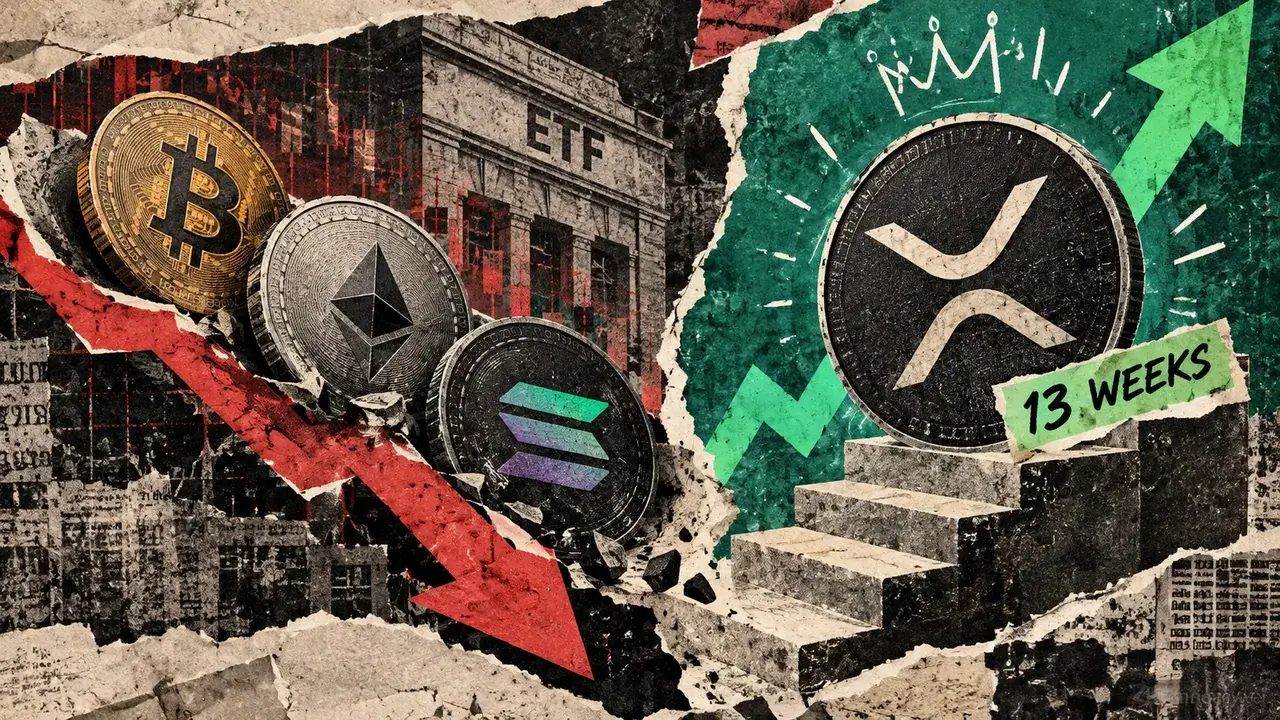
XRP ETFs extend a 13-week inflow streak as Bitcoin, Ethereum and Solana funds shed $1.25 billion
US-listed XRP ETFs extended their inflow streak to 13 weeks as Bitcoin, Ethereum and Solana funds suffered nearly $1.25 billion in...