DeFi Was Never Going to Get Its Clarity from US Congress
Last week’s failed CLARITY Act cloture vote will be read as a setback for crypto. That reading misses where decentralized finance (DeFi) compliance was actually heading. London's trading industry is coming home!Investors...
Watchlist
Published in the last two hours. Multiple named entities are involved.
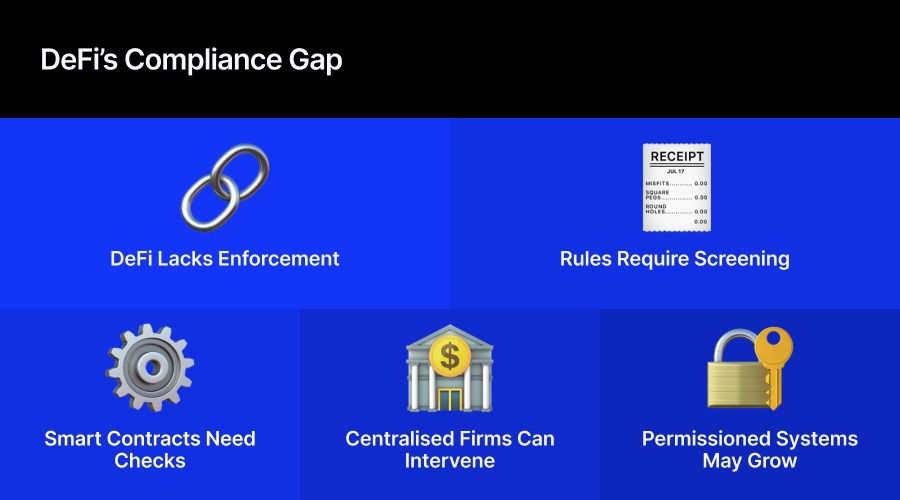
Last week’s failed CLARITY Act cloture vote will be read as a setback for crypto. That reading misses where decentralized finance (DeFi) compliance was actually heading.
London's trading industry is coming home!
Investors have been watching legislative headlines while the decisions that will govern DeFi access, sanctions screening, and pre-settlement risk checks get written elsewhere.
CLARITY Doesn’t Set the Rules
The industry treated CLARITY as the moment it would finally get regulatory certainty. The bill was never going to deliver that. It covered a lot of ground, including AML program requirements, protections for developers, and jurisdictional lines defining which agencies would regulate different kinds of cryptocurrencies.
The questions that actually determine how much of DeFi stays open to anyone with a wallet, and how much becomes gated by compliance checks, would continue to be kicked down the road. The bill handed those specifics to agency rulemaking, and for AML-type screening, the relevant agency is Treasury.
A failed vote doesn't pause regulation because CLARITY was never delineating the rules. Treating the failure that way just means DeFi keeps waiting to react to rules it could be helping shape.
The SEC Has Already Shown Us What's Coming
Rulemaking didn’t need CLARITY and won’t wait for it or another bill like it. The SEC has already shown how it plans to regulate the industry. Rather than writing one comprehensive framework, the agency has been issuing narrow, conditional rules one at a time, each with tight limits on who qualifies and how long the relief lasts.
In August of this year, the SEC announced Regulation Crypto Assets, proposing new rules for how crypto projects can raise money by selling tokens. The exemptions are tightly capped: $5 million over four years for early projects, and $75 million a year for larger raises only if the issuer provides financial statements and ongoing reporting.
Last week, two days after the CLARITY cloture failed, they followed this up with the Innovation Exemption, clarifying how permissioned pools could legally offer tokenized equities. The exemption is similarly constrained, with caps on how many stocks each venue can list and how much each can trade, as well as requiring venues to screen who can trade. It expires after five years.
Together, these two announcements show what rulemaking for crypto is likely to look like in action. The industry should expect regulation to happen under a very narrow set of conditions as the SEC collects data on the effect regulated DeFi will have on existing markets. Once that is better understood, a broader set of conditions and legislation from Congress is likely to follow.
The emergence and adoption of AI is likely to slow Congressional legislation timelines down even further, as it becomes the emerging tech sector that demands regulators’ attention.
Crypto shouldn’t expect sweeping regulation to come quickly. The SEC’s slow and steady progress on specific interpretations of existing laws is more likely to be the default.
Crypto Needs Its Own Enforcement Layer
Either way, DeFi isn't structurally prepared for regulation. The rules being written elsewhere all assume DeFi can enforce them, but right now only permissioned venues, like centralized exchanges, are positioned to actually enact them.
Smart contracts ensure trustlessness only within very specific parameters. As more rules take effect, the code will need enforceable ways to check that transactions comply.
In traditional finance, that job belongs to payment networks like Visa, but crypto has no equivalent layer. That gap leaves the industry exposed, putting at risk the openness that decentralization promised. Without a way to run these authorization checks natively, centralized companies will run them instead.
If DeFi doesn't build that enforcement layer itself, the only blockchain infrastructure that can actually comply will be the kind banks run: permissioned, gated, and pointed back at the same institutions DeFi was built to route around. The SEC has shown it won't wait for permission from Congress. DeFi shouldn't either.
This article was written by Mohammad Akhavannik at www.financemagnates.com.Why this matters
SEC is showing up inside the Regulation theme, so this story is worth tracking for follow-through rather than treating it as a one-off headline.
Original source
Read on Finance MagnatesRelated market context

Microsoft Copilot AI Predicts Bitcoin Will Do Something Incredible in Q4 2026
Microsoft Copilot AI predicts a wild move for BTC in Q4 2026, calling it one of the strongest asymmetric risk-reward positions ava...

Fed proposes stablecoin rules under GENIUS Act, eyes crypto clarity
The Fed's stablecoin rules could enhance regulatory clarity, potentially fostering a supportive environment for the broader crypto...
![[[alloc] init] Releases Shielded Bitcoin Proposal For Private Bitcoin Transactions](https://bitcoinmagazine.com/wp-content/uploads/2026/09/shielded2-scaled.jpeg)
[[alloc] init] Releases Shielded Bitcoin Proposal For Private Bitcoin Transactions
Bitcoin Magazine [[alloc] init] Releases Shielded Bitcoin Proposal For Private Bitcoin Transactions Shielded Bitcoin is a proposal...

XRP Price Prediction: Weekly Gains Lead Crypto Market, But Can XRP Clear $1.63?
XRP price trades at $1.53, up by a marginal 1.5% on the day, and is still sitting on one of the strongest weekly charts among larg...

Ondo unlocks BlackRock portfolio strategies, but only non-US traders benefit
Ondo Finance launched three on-chain portfolio tokens on Sept. 24 using investment strategies BlackRock developed for the company....

CFTC Declares ‘It’s Go Time’ for Crypto Rules as Agencies Act Without Congress
CFTC Chair Mike Selig says the agency will write crypto rules without Congress after the Clarity Act failed. Perps platforms Hyper...