Hut 8 Expands AI Campus Commitments While Funding Buybacks With Bitcoin Sales
TL;DR: Hut 8 says it fully commercialised its Beacon Point AI campus with a second 352 MW lease, taking expected aggregate base-term contract value across its AI data-centre portfolio to about $26.6 billion. The company...
Watchlist
Published in the last two hours. A tracked entity is involved.
TL;DR: Hut 8 says it fully commercialised its Beacon Point AI campus with a second 352 MW lease, taking expected aggregate base-term contract value across its AI data-centre portfolio to about $26.6 billion. The company also sold Bitcoin to fund share repurchases, showing how mining-era assets are being redeployed.
Hut 8’s third-quarter update is less about how many coins it mined and more about how much power, construction capacity and long-term tenant demand it can assemble. That represents a significant shift for a company long associated with Bitcoin infrastructure.
In its November 4 results, Hut 8 said a second 352-megawatt IT lease at Beacon Point fully commercialised the campus. It placed expected aggregate base-term contract value across its AI data-centre portfolio at about $26.6 billion and reported 1,330 MW of utility capacity under construction across its major AI projects.
Long leases are not the same as realised revenueThe numbers describe commitments over years, not cash that has already appeared in the bank. Hut 8’s timetable includes an initial River Bend data-hall delivery target in the second quarter of 2027, followed by Beacon Point Phase 1 in the third quarter of 2027 and Phase 2 in the second quarter of 2028.
Those future dates matter. A contracted tenant can improve the business case for a development, but execution still depends on power availability, construction, testing, financing and customer readiness. The risk profile is not identical to Bitcoin mining, where machines may be deployed in stages and production responds directly to network conditions.
Hut 8 also reported 1,300 MW of additional energy capacity entering exclusivity, bringing that category to 3,180 MW. Exclusivity is a development milestone; it should not be interpreted as an operating facility or a guaranteed utility connection. Investors need to track the movement from a pipeline into actual delivered infrastructure.
Why its Bitcoin treasury mattersThe company said it bought back $74.7 million of shares during the quarter, funded with proceeds from selling approximately 954 Bitcoin. It later repurchased another $175.3 million of shares, funded through the sale of roughly 2,148 additional Bitcoin. Subsequent to the quarter, the repurchase authorisation increased to $1 billion.
That is a revealing capital-allocation decision. Selling Bitcoin to repurchase shares reduces treasury exposure to the coin while potentially increasing each remaining shareholder’s proportional interest in the company. Whether that creates value depends on the repurchase price and long-term performance of the business.
Hut 8 also closed a $1.07 billion senior secured revolving credit facility. The existence of a facility adds flexibility, but readers should distinguish committed borrowing capacity from cash revenue or money actually drawn. NewsBTC has previously examined the financing pressure created by miners’ AI expansion, and Hut 8 offers a clear example of how those choices reach the balance sheet.
The real milestones are still aheadHut 8 has a substantial development pipeline and named delivery targets. The crucial tests will be whether those targets are met, whether project-level financing stays on acceptable terms and how much profit flows through when sites become operational.
The update captures a broader change in listed Bitcoin infrastructure businesses. Their market stories increasingly revolve around electricity access and long-term AI customers rather than the number of Bitcoin retained. That can produce a different revenue profile, but it does not remove the need for disciplined spending or independently verifiable execution.
This article was written by the News Desk and edited by Samuel Rae.
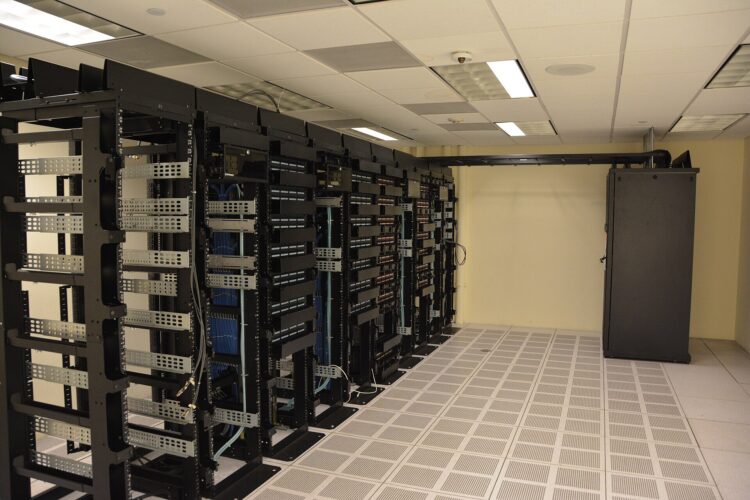
Featured image: Illustrative photograph of data-centre server racks (does not depict a Hut 8 campus). Photo: Carl Lender via Wikimedia Commons, licensed under CC BY 2.0.

Why this matters
Bitcoin is showing up inside the Institutional Adoption theme, so this story is worth tracking for follow-through rather than treating it as a one-off headline.
Original source
Read on NewsBTCRelated market context
IREN’s Bitcoin Mining Revenue Falls as AI Cloud Sales Nearly Triple
TL;DR: IREN reported $200 million in quarterly AI Cloud revenue, up from $71 million the previous quarter, while Bitcoin mining re...
TeraWulf Says AI Leasing Now Generates 83% of Revenue as Bitcoin Mining Recedes
TL;DR: TeraWulf’s November 6 earnings release shows $63 million in third-quarter high-performance-computing lease revenue, around...
BitFuFu’s October Bitcoin Mining Output Falls Despite Steady Hashrate
TL;DR: BitFuFu produced 137 BTC in October, down from 167 in September, while managed hashrate stayed close to 19.5 EH/s. The mine...
Riot Sells More Than 20,000 Bitcoin as AI Data-Centre Contracts Reach $38B
TL;DR: Riot Platforms says it sold 20,264 BTC in the first nine months of 2026, raising about $1.5 billion primarily for data-cent...
Texas Voted to Pause New Data Centers. Which Bitcoin Miners Are Already Past the Freeze?
Bitcoin miners that turned into AI landlords have been valued on how many megawatts of power they control and how much of it sits...

Strive Reports $509M Quarterly Profit as Bitcoin Buying Accelerates
TL;DR: Strive reported $509 million in third-quarter GAAP net income and said it purchased 8,136 BTC during the quarter, followed...